INSPIRATION


Nikola Tesla, the greatest mind of all the time, was not just an investor or as claimed by many the true father of the electric age but also a man with secrets and mysteries we could never imagine of. Despite the fact that he was famous but not as much as he should have been, as most of the patents were registered by Edison or Westinghouse, Tesla himself, was altruistic, and when he learned of others using his ideas, he probably wished them well. He wasn’t financially motivated beyond survival, and he sought to share his ideas with the entire world, either by him or by others. One of his most floated theories is Tesla 3 6 9 Number Theory.
Tesla did countless mysterious experiments, but he was a whole other mystery on his own. As a famous saying goes “The greatest minds are always curious”, goes well on Nikola Tesla.
Some said he had OCD and some believed he was superstitious, but what Tesla said was –
If you knew the magnificence of 3 6 and 9, you would have a key to the universe.
We may have come across this quote claiming to be said by Tesla all over the internet, but there is no reference anywhere to it is being truly said by him. Even though there is no proof, but the facts and things Tesla used to do make it more believable that he was obsessed with these numbers and it can conclude the quote to be genuine.
Moreover, the significance of number three just not known by Tesla but a lot of other people of this era relate to the number three. It could make more sense taking real-life examples, from an atom consisting of three subatomic particles (proton, neutron, and electron), to Holy Trinity (God, Jesus, and Holy Spirit) from the Holy Bible. Egyptian mythology also featured three gods that represented heaven, earth, and the abyss.
Moreover, the evolution of our ideas are from the Past, our experience is always the Present, and all our imaginations and aspirations are of the Future making the three Kaal (Sanskrit for Time)
Nikola Tesla was obsessed with numbers, but especially 3, 6, and 9. He wanted the world to know the significance of the number 3 6 9, he claimed that these were extremely important numbers, but the question is why?
What was that Nikola Tesla wanted the world to understand? How it becomes Nikola Tesla 3 6 9 theory?
To understand that, we must first know about Mathematics. Why it is so different yet the same anywhere in the universe. Math was and has been the most valued subject of all time and the most powerful too. Two plus two will always be four everywhere in the universe. Possibly, Nikola Tesla knew the power of the numbers 3 6 9.
The Golden ratio in Mathematics is a special number found by dividing a line into two parts such that the longer part divided by the smaller part is also equal to the whole length divided by the longer part. It is often symbolized using phi, after the 21st letter of the Greek alphabet. In an equation form, it looks like this:
a/b = (a+b)/a = 1.6180339887498948420 …
The Golden ratio was used to achieve balance and beauty in many Renaissance paintings and sculptures. Da Vinci himself used the Golden ratio to define all the proportions in his Last Supper, including the dimensions of the table and the proportions of the walls and backgrounds. The Golden ratio also appears in da Vinci’s Vitruvian Man and the Mona Lisa.
There are patterns that naturally occur in The Universe, patterns we’ve discovered in life, galaxies, star formations, evolution, and almost all natural systems, and The Golden Ratio is one of them.

Being said that, Mathematics was and still is one of the most powerful and important languages, used for centuries by great minds. Mathematics or numbers is the cradle of all creations. Without this, the world cannot move even an inch. Every human being, everyone, needs mathematics in their day-to-day life. Even animals, plants, and insects have the Golden ratio, the geometrical pattern, they use mathematics in their everyday life for existence. There must have been at least some reason that Tesla was obsessed with equations and numbers.
In Vortex Math (Science of Torus Anatomy). if you follow a specific pattern as in the image below, you will have something like this –

As you can see, starting with 1, and doubling it (1+1) we got 2, again, doubling 2 (2+2) we got 4. Further doubling 32 (32+32) we got 64 and summing up 6+4 gave us 10 which again summing up the two digits gave us 1. If you keep following this pattern, It will always give us the digits 1, 2, 4, 5, 7, 8. Even summing 7+7 gives 14 which further gives 5 (1+4).
Notice how 3, 6, and 9 are not in this pattern. Scientist Marko Rodin (Discoverer of Vortex Maths) believes these numbers represent a vector from the third to fourth dimension which he calls a “flux field.” This field is supposed to be higher dimensional energy that influences the energy circuit of the other six points (1, 2, 4, 5, 7, 8).
Things start getting strange from here … If you take these 3 numbers (3, 6 and 9), starting with 3 and doubling it (3 + 3 = 6; 6 + 6 = 12; 1 + 2 = 3), you will find that there is no mention of 9 !
We find lots of evidence that nature uses threefold and sixfold symmetry, including the hexagonal tile shape of the common honeycomb. Interestingly not just in nature but also the ancient establishments have this symmetry. One of the greatest of them all is the Giza – Orion correlation theory.
According to which there is a correlation between the location of the three largest pyramids of the Giza and Orion’s Belt of the constellation Orion, and that this correlation was intended as such by the original builders of the Giza pyramid complex. The stars of Orion were associated with Osiris, the god of rebirth and the afterlife by the ancient Egyptians. Depending on the version of the theory, additional pyramids can be included to complete the picture of the Orion constellation, and the Nile river can be included to match with the Milky Way galaxy.
We also see a group of three smaller pyramids immediately away from the three larger pyramids, which makes the total number of pyramids to be 6. Three pyramids correlate with the constellation Orion. Is it a coincidence, or there exist a significance of 3 and 6?

Nikola Tesla quoted –
If you want to find the secrets of the universe, think in terms of energy, frequency and vibration.
Is it possible that there is something special about these mysterious numbers, 3, 6, and 9, tesla 3 6 9? Was 3 6 9 Tesla’s code? Is it possible that Tesla uncovered this profound secret and used this knowledge to push the boundaries of science and technology?
We don’t know, but we definitely find it fascinating how these numbers do relate to the universe in some way.
By TAMMY PERKIN

Working with an executive coach can have a huge payoff for leaders as they develop, improve their skills and stretch in new areas. Like anything in life, coaching is as much about what you give as what you get back.
Throughout my career, I’ve acted as an executive coach, working with leaders to tap into their potential, set and achieve goals, and transition into new roles, while also learning how to coach others. Along the way, I’ve learned a lot from my own coaches and mentors.
Creating a strong foundation of trust is the first step in any coaching relationship. A great executive coach is a thinking partner, someone you can talk openly with who provides support, guidance and an objective viewpoint, while also helping you problem solve and explore new ideas to reach your goals. Building this type of trust with a coach can only be established over time, gradually, through a series of successful meetings. It takes commitment, hard work and confidentiality on both sides.
An example of a successful coaching relationship I developed was with a rising executive at Amazon. As a bright, ambitious and high potential leader, he operated at lightning speed to deliver results. This could be a towering strength and opportunity, but also could be challenging when he moved faster than his team.
We met regularly and developed a framework to have candid discussions around his approach as a new leader taking on a global team. Among the areas we covered were best practices for navigating a new environment, and various leadership skills he wanted to develop, grounded with specific examples and insights. By building a foundation of trust, he was able to leverage our coaching sessions to better navigate, approach and influence the organization, while successfully leading his team to reach and exceed their goals.
Sometimes, coaching doesn’t work. Find out the reasons in “Why Coaching Doesn’t Always Work“
Getting the most out of executive coaching takes both emotional IQ and investment. In order to grow from good to great, you have to be willing to invest time to not only amplify and develop your strengths, but identify and address potential blind spots.
Here are 5 tips to help a leader get the most out of the executive coaching experience.
Getting the most out of coaching starts with an open mind and an honest self-appraisal your strengths and vulnerabilities, leadership style, personality traits and potential challenges. An executive coach can help you become more self-aware, identify blind spots and potential derailers, which in turn improves your decision-making, communication and ability to effectively lead others.
Having too narrow a focus can limit your perspective as well as potential opportunities. A great coach will help you to see the bigger picture and think outside your comfort zone. This may include stretching in new areas, seeking out new opportunities for professional growth or talking openly with peers or mentors to look at a particular challenge from a different angle.
While everyone has development areas to work on, it’s important to build your goals around your strengths first. An executive coach can help you develop a framework for your goals keeping you focused and on-track, while also developing your vision for where you want to go.
My executive coach helped me learn there were times when my strengths could also act as weaknesses, especially in situations when I took on more work than I should. My tendency to offer to “carry the piano” on commitments or projects could lead to unrealistic goal setting for my team and me. Working with a coach helped me learn to set realistic boundaries and overcome self-doubt.
At the end of the day, the best leaders are those who are able to clearly communicate their vision, co-create a plan with their team and execute it successfully, while maintaining balance. In order to get the most out of coaching, you need to create both time and space in your life to learn and grow beyond where you are today.
Stepping into any leadership position takes courage, grit, motivation and emotional intelligence. Executive coaching can make a huge difference in the trajectory of your career if you embrace it and put in the hard work to stay humble and challenge yourself to improve, while also seeking out new mentors and learning opportunities.
Your coaching philosophy is the set of values, beliefs and principles that guide your coaching. These values and principles drive your approach and behaviour in both coaching and life. Everyone has these values, and they drive behaviour. However, not everyone, or even every coach, has taken the time to articulate them and be clear about them—so they are not always sure what is driving their decisions.
Consistency and clarity matter when coaching. It is therefore important to be clear about your basic coaching philosophy before you start coaching anyone. This page explains how you can start to develop a clear and coherent philosophy that reflects your beliefs and values, and will guide your coaching as you develop your skills.
Why do you need to articulate a coaching philosophy? You may feel that you already know what you value and how to behave, and have no need to write anything down.
However, there are benefits to setting out a philosophy, including:
Ideas that are not articulated are often forgotten. When you start coaching, you may believe that you are clear about what guides you. Over time, however, you may become cynical or jaded. Being able to return to your guiding principles will help you to remember why you became a coach, and what really matters.
We have many beliefs and values, and not all of them are always relevant to the situation. We all bring ‘baggage’, including values that may not be relevant in coaching—or may even be harmful! It is therefore helpful to be clear which values are guiding your approach, and which you wish to put aside.
It will enable you to coach within a clear framework and manage any ethical dilemmas. If your philosophy is clearly defined, you can set any ethical issues or dilemmas clearly within that structure. This will make it easier to avoid problems and make sure that you behave consistently.
It will help others to see if your values and principles fit with theirs. Potential clients can look at your philosophy to see if it chimes with their own values. This is helpful in ensuring a good ‘fit’ between client and coach.
It supports reflective practice.Your philosophy can be used as a framework for reflection on your practice, including with any kind of peer mentor or coach support.
Beliefs, Behaviour, and Values
It is tempting to think that coaching is all about behaviour—and, to a certain extent, this is true. Any coach will be modelling behaviours to those they are coaching. However, there is considerable evidence that behaviours are only the outward reflection of our beliefs and values.
Robert Dilts set out a hierarchy of what he called ‘logical levels’ (see diagram). The basic principle behind these levels is that each level affects the levels below—but not necessarily those above.
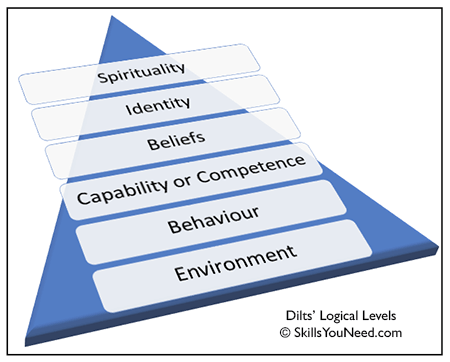
In other words, identity and beliefs drive how we behave—rather than behaviours driving beliefs. If you wish to change your behaviour, you therefore need to examine your beliefs and competences, and not merely your behaviour.
For most of us, beliefs are deeply held, and not often articulated. They may go right back to childhood. They are not always easy to surface—but it is important to identify those that will affect your coaching.
Every coach’s philosophy will be different. However, there are certain components that are generally agreed to be important. These include the objectives or purpose of coaching, your approach to coaching, your values, and your principles.
We can define these as the Why (purpose), How (approach) and Ideals (values) of coaching.
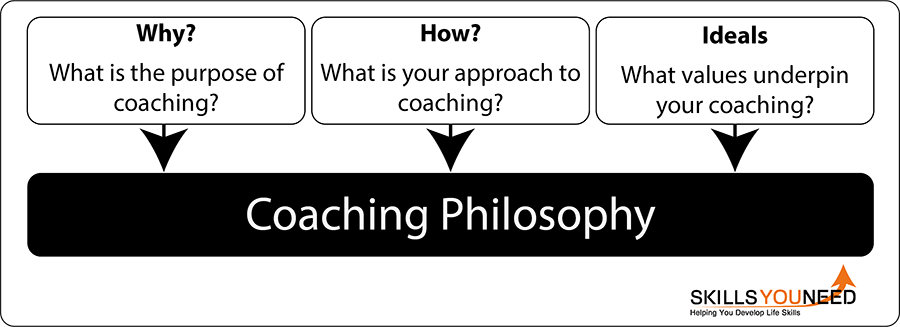
A good place to start to develop a coaching philosophy is by considering these four key questions:
Why do you want to coach (or why did you start coaching)?
What do you really like about coaching (what makes you feel good about it)?
How do you define success in coaching for you and those you coach?
What is your general approach to coaching?
When you can articulate answers to all these, you have the basis of a coaching philosophy.
Top Tip! Consider real situations
If you are having trouble answering any of these questions, it may be helpful to think about some real situations. Consider the situation, how you responded, and how that made you feel.
Your feelings about certain situations are often tied up in your beliefs. If you feel uncomfortable about how you behaved, that is probably because it was not fully consistent with a belief or value. This can therefore help you to identify values that really matter.
You can now try to write your coaching philosophy. A useful approach is to start with your objectives, move onto your core values, and then set out what approach you will use. Your coaching philosophy may be just a sentence or two, or it may be several paragraphs long. The important thing is that it sets out what you believe is important in coaching, and how that is reflected in what you do.
Your coaching philosophy also needs to be set in the context in which you coach. What is appropriate for someone coaching a national team may not fit a work context, or coaching a group of children learning a new sport.
The box below shows some examples of coaching philosophies, one from a coach at a canoe club, and one from a team leader in a large organisation. Both use the format above, and both also set the coaching into context.
Examples of coaching philosophies
“For me, coaching is about helping other people to enjoy canoeing, and to improve their skills. I want them to come back and want more. I also want them to experiment with what they do, and be prepared to try new things. I am there to support them, and provide opportunities for development. Ultimately, though, it is up to them to drive their own progress.”
“At work, coaching leadership is all about giving people confidence that they can solve their own problems. A coaching approach means I can use questions to help them think through the problem, and discuss potential issues, but in a way that lets them take the lead in the thinking process. Success for me is watching the problems that people bring to me for discussion get harder, as they get more confident in solving the easier problems themselves!”
Writing your coaching philosophy is only the first step. You then have to use it to guide your coaching. It needs to underpin everything that you do.
When you first start coaching, it is worth consciously considering your philosophy with each decision you make. Over time, this process will probably become more unconscious, but it is still worth going through. This will ensure that your decisions are consistent and coherent—and will also help you to justify them to yourself and others if necessary.
Your coaching philosophy will also inevitably change over time as you grow and mature as a coach (and our page on Coaching Maturity explains more about this process). You may find that you develop different values, or that you come to believe that other things are more important. These changes need to be taken into account in your philosophy. It is therefore worth reflecting on your philosophy periodically, perhaps with a peer mentor, to ensure that it changes with you—but continues to guide your practice.
https://www.skillsyouneed.com/learn/coaching-philosophy.html
My Favorite Jordan Peterson's YouTube Videos 1, Jordan Peterson | Motivational Speech 2023 - YouTube A life changing and powerful motiva...



.png)

